


The Visionary CEO’s 2025 Playbook: Turning Sustainability from Ambition into Pragmatic Growth
For years, the corporate sustainability conversation has oscillated between soaring rhetoric and quiet retreats. But in 2025, a profound and powerful shift is underway. According to Bain & Company’s seminal report, “The Visionary CEO’s Guide to Sustainability 2025,” we’ve entered The Age of Pragmatism.
Gone are the days of sustainability as a purely moral or communications exercise. Today’s forward-thinking CEOs are turning down the volume and radically accelerating action. They are seamlessly integrating sustainability into the core mechanics of their business—driving value, mitigating risk, and unlocking new growth vectors.
This isn’t a niche trend; it’s a fundamental re-evaluation of business strategy. With 2030 targets now visible on a typical CEO’s five-year planning horizon, the pressure to deliver tangible results is immense. But as Bain’s research reveals, this pressure is also the catalyst for unprecedented innovation and commercial opportunity.
In this deep dive, we unpack the critical insights from Bain’s global study, providing a roadmap for business leaders ready to move beyond talk and harness the power of pragmatic sustainability.
The New CEO Mandate: Embracing the “Do-Say” Gap
One of the most striking findings from Bain’s analysis of over 35,000 CEO statements is the emergence of the “do-say gap.” While public rhetoric on sustainability has softened from its peak, corporate action has intensified. Why? Because CEOs are now framing sustainability not as a standalone goal, but as a direct lever for business value.
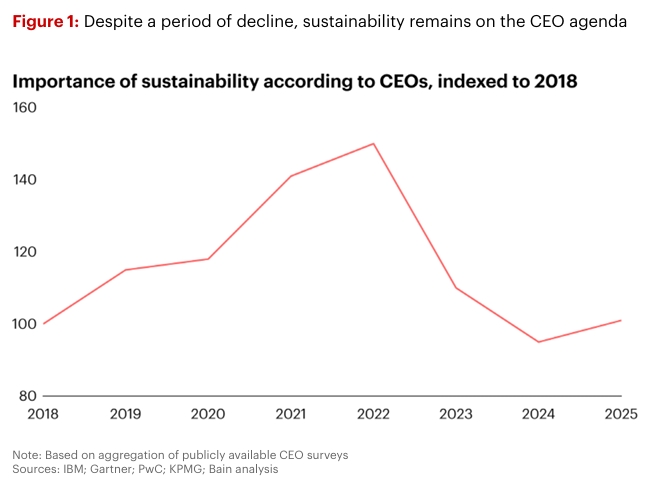
Bain’s AI-powered Sustainability Pulse tool tracked the evolution of CEO language from 2018 to 2024. The data shows a clear pivot:
- 2018: Focus on compliance, corporate social responsibility (CSR), and “doing good.”
- 2024: Focus on business value—costs, customers, commercial motions, and capital investments.
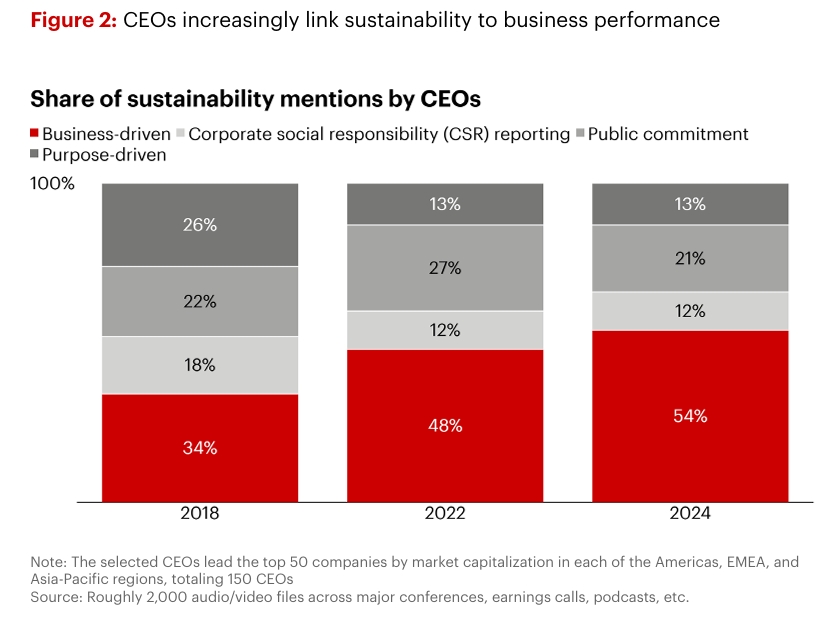
The “quiet CEO” speaks less about sustainability in abstract terms but is deeply focused on its concrete impact on the P&L. This is a sign of maturity, not retreat. Evidence of this continued commitment is everywhere:
- 10% of companies have increased their Science-Based Targets initiative (SBTi) ambitions, while only 4% have scaled back.
- Two-thirds of companies are on track to achieve their Scope 1 and 2 emissions targets.
The message is clear: sustainability is being baked into business-as-usual. To navigate this new landscape, Bain identifies three pragmatic questions every CEO must answer.
1. How Can We Accelerate Where Sustainable Impact and Business Value Already Align?
The most immediate opportunity lies in leveraging initiatives that are already profitable. Bain’s proprietary Decarbonization Lever Library, analyzing 14 industries representing two-thirds of global emissions, reveals a powerful statistic: levers that are already ROI-positive today can abate 25% of global CO₂ emissions.
These aren’t futuristic technologies; they are available, scalable solutions that improve efficiency, reduce waste, and cut costs. Examples include:
- Energy efficiency upgrades in manufacturing and buildings.
- Circular design principles that reduce material use.
- Supply chain localization to minimize logistics emissions.
The Case of the European Agribusiness: One company identified ROI-positive levers to cut farm emissions by over 30%. However, due to farmer workload and manual processes, only a third of this potential was being captured. The solution wasn’t more technology, but less friction. The company launched a digital platform that automated 80% of the 200+ data points farmers needed to track. The result? Reduced emissions, marketable transparency, and new revenue from premium products, which were reinvested to drive further farmer buy-in.
The Takeaway: Don’t overlook the low-hanging fruit. Identify, scale, and integrate high-ROI sustainability levers into your core operational decision-making. The business case is already there.
2. How Do We Anticipate the Next Disruption in Policy, Technology, and Customer Behavior?
Deploying today’s profitable levers is essential, but it won’t be enough. Bain calculates that an additional 32% of global emissions can be abated with levers that have the potential to become ROI-positive in the medium term. The pace of this transition will be dictated by three forces: policy, technology, and customer behavior. Their interplay creates inflection points that reshape entire markets.
In 2025, policy is the most dynamic lever. While the US and EU are seeing a rollback of certain regulations, fast-growing economies are aggressively using sustainability as a cornerstone of industrial policy.
China’s Battery Dominance: Beijing identified battery costs as the chokepoint for electric mobility and moved strategically on three fronts:
- R&D Promotion via the “Made in China 2025” mandate.
- Scaling National Champions like CATL and BYD, securing access to critical raw materials (China now refines 70% of global battery-grade lithium).
- Driving Adoption through falling prices, high quality, and dense charging infrastructure.
The result? China has a commanding scale and cost advantage in both electric vehicles and grid storage, a market inflection point that caught many Western companies off-guard.
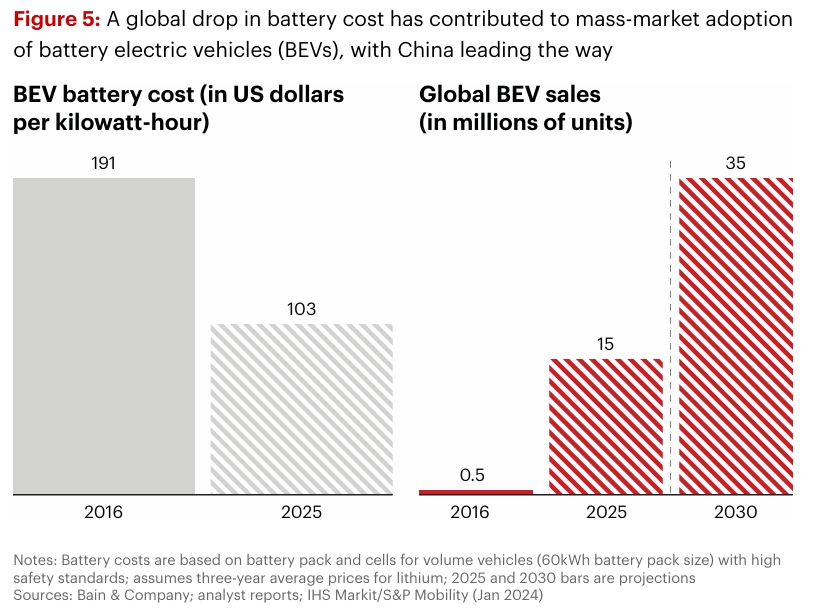
The Takeaway: Leaders must become adept at “future-sensing.” Prioritize early signal detection in policy and technology. Be prepared to pivot quickly as cost curves shift and new profit pools emerge. Flexibility is key, as technology costs rarely fall in a straight line—as demonstrated by the stunning, unforeseen plummet in solar energy costs.
3. How Do We Build a Robust (Eco)System That Bends But Doesn’t Break?
The final portion of emissions—nearly 50%—are likely to remain ROI-negative beyond 2050. This stark reality means CEOs must prepare their organizations for a world of accelerating disruption, from climate change to geopolitical shocks.
The prevailing corporate model of hyper-efficiency and optimization is becoming a liability. Bain introduces a compelling concept from biology: robustness.
As French scientist Olivier Hamant notes, natural systems thrive through redundancy, diversity, and adaptability—”inefficiencies” that serve as shock absorbers. This stands in sharp contrast to lean, just-in-time supply chains that are brittle under stress.
Building a Robust Organization:
- Supply Redundancy: Limit exposure to region-specific extreme weather by diversifying suppliers.
- Real-Time Sensing: Deploy systems to anticipate and respond to changing conditions.
- Portfolio of Levers: Maintain a broad portfolio of climate solutions, even those not yet ROI-positive, ready to activate as conditions change.
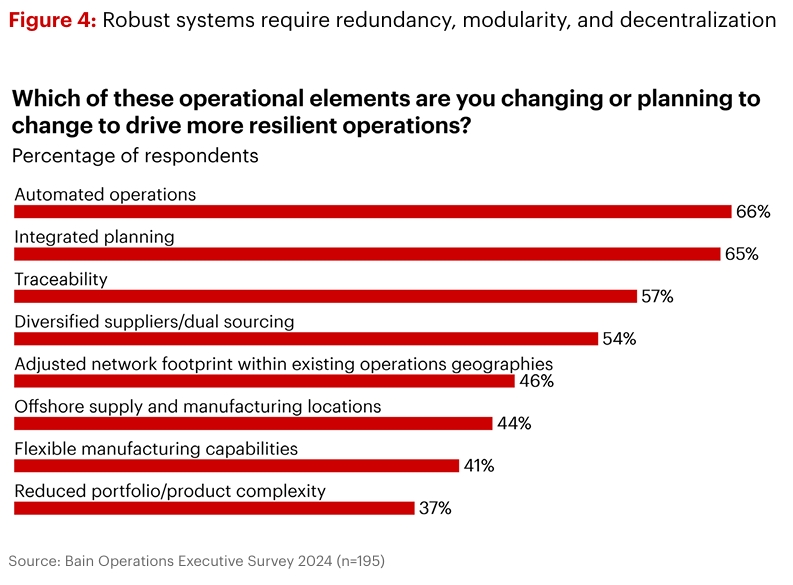
This approach extends beyond individual companies. “Anchor firms”—large, influential companies—have a responsibility to strengthen their entire ecosystem, including customers, value chains, and regulators.
The Takeaway: Balance short-term efficiency with long-term robustness. Make resilience a design principle, not an afterthought. The choices you make about your operational structure will determine your ability to withstand the shocks of the coming decade.
The Consumer Conundrum: A Market Eager to Buy, Held Back by Poor Choices
Bain’s annual survey of over 14,000 consumers in eight countries paints a clear picture of the “overloaded consumer.” Worried about geopolitics, economic pressure, and global crises, today’s citizens are carrying a heavy mental load. Yet, amid the noise, sustainability has not been tuned out.
Key Consumer Insights:
- 79% of consumers remain deeply engaged on environmental issues.
- 80% believe their individual choices make a difference.
- 70% of the global population wants to live more sustainably, even if it isn’t easy.
Bain’s annual survey of over 14,000 consumers in eight countries paints a clear picture of the “overloaded consumer.” Worried about geopolitics, economic pressure, and global crises, today’s citizens are carrying a heavy mental load. Yet, amid the noise, sustainability has not been tuned out.

Key Consumer Insights:
The most surprising adopters? Baby Boomers. Over the past three years, they have added more sustainable habits than even Gen Z, thanks to their relative wealth and life stage (e.g., installing solar panels).
However, a massive gap exists between intention and action. Consumers face persistent barriers:
- Cost: 47% say it costs more to live sustainably.
- Accessibility: 38% say barriers to access limit them.
- Quality & Performance: Sustainable options often disappoint.
- Confusion: Inconsistent labeling and “greenwashing” create distrust.
Faced with these poor choices, consumers are increasingly choosing to consume less. This “de-consumption” is a powerful market signal:
- 38% are buying fewer disposable items.
- 21% are cutting down on meat and dairy.
- 20% are purchasing secondhand items.
The Takeaway for Business:
This is a business problem, not a consumer problem. There is a vast, motivated market being held back by friction that companies have the power to remove. The solution requires a two-pronged approach:
- Erase Trade-Offs Through Innovation: The next wave of innovation must deliver affordability, quality, and sustainability without compromise. Look to the success of LED lighting, plant-based milks, and refillable packaging as proof of concept.
- Close the Knowledge Gap with Technology: Over half (54%) of generative AI users are already using tools like ChatGPT to live more sustainably. Brands that provide accurate, transparent, and accessible product data will win consumer trust—and the algorithm’s recommendation.
The B2B Growth Engine: How Sustainability is Driving Commercial Value
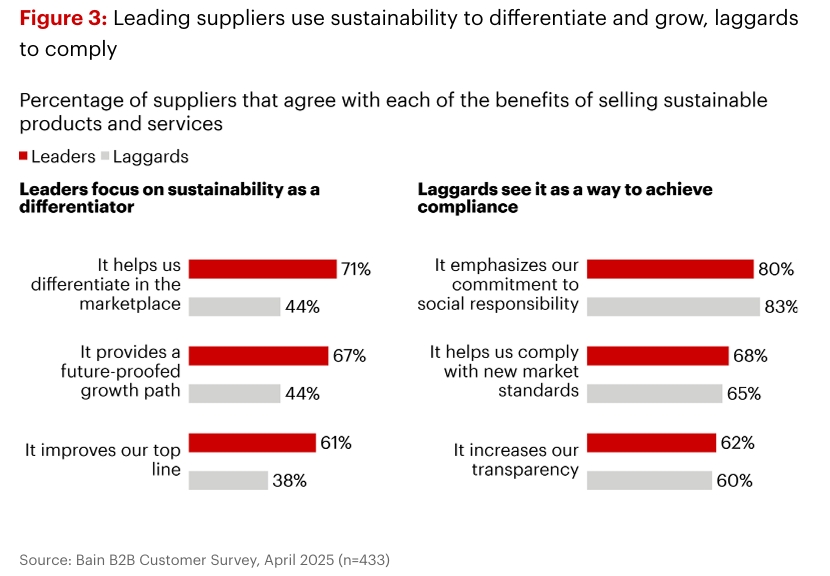
While consumer markets grapple with intention, the B2B world is seeing a direct and powerful link between sustainability and commercial performance. Bain’s survey of 750+ B2B companies reveals that sustainability is firmly on the commercial agenda, especially for revenue growth leaders.
Dispelling the B2B Myths:
- Myth: Sustainability is flatlining.
- Reality: Half of B2B customers already assign more business to sustainable suppliers, and 68% plan to accelerate this within three years. By 2028, sustainability will be the second-most important purchasing criterion, just after quality.
- Myth: Sustainability is a cost center.
- Reality: 90% of growth leaders expect sustainability to have a positive business impact. They use it to differentiate, future-proof their business, and grow revenue. More than 80% of B2B buyers pay a premium for sustainable products, with one in three willing to pay over 5% extra.
- Myth: Selling sustainable products is just like selling anything else.
- Reality: It demands a different mindset and skills. Sellers often misunderstand customer priorities, overestimating the importance of safety and underestimating the criticality of reducing Scope 3 emissions (those embedded in the products they buy).
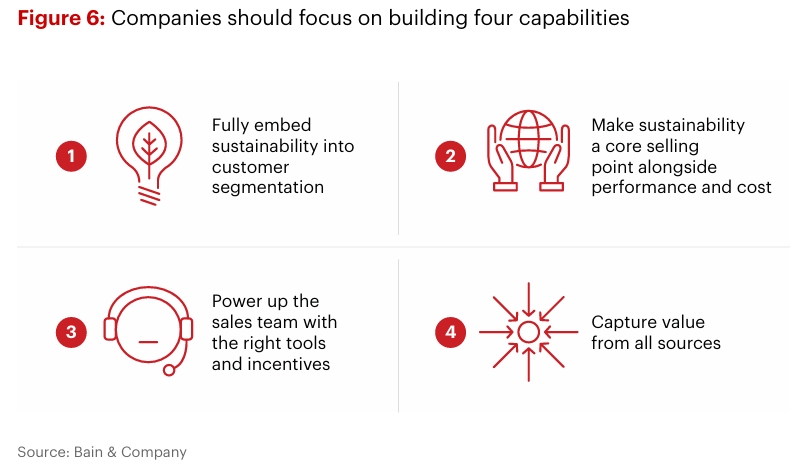
The B2B Leadership Playbook: Leaders outperform laggards by building four core capabilities:
- Embed sustainability into customer segmentation, using AI to identify high-potential customers.
- Make sustainability a core selling point alongside performance and cost, quantifying the business case with rigor.
- Power up the sales team with the right tools, training, and incentives (39% of leaders tie compensation to sustainability metrics vs. 15% of laggards).
- Capture value from all sources, using sustainability to gain market share, access attractive segments, and command price premiums.
The AI Dilemma: Accelerator of Progress or Source of New Risk?
Artificial Intelligence is poised to be one of the most powerful tools in the sustainability arsenal—if managed correctly. 80% of executives see high potential for AI to accelerate their sustainability goals, but over 50% of projects are still in early pilot phases.
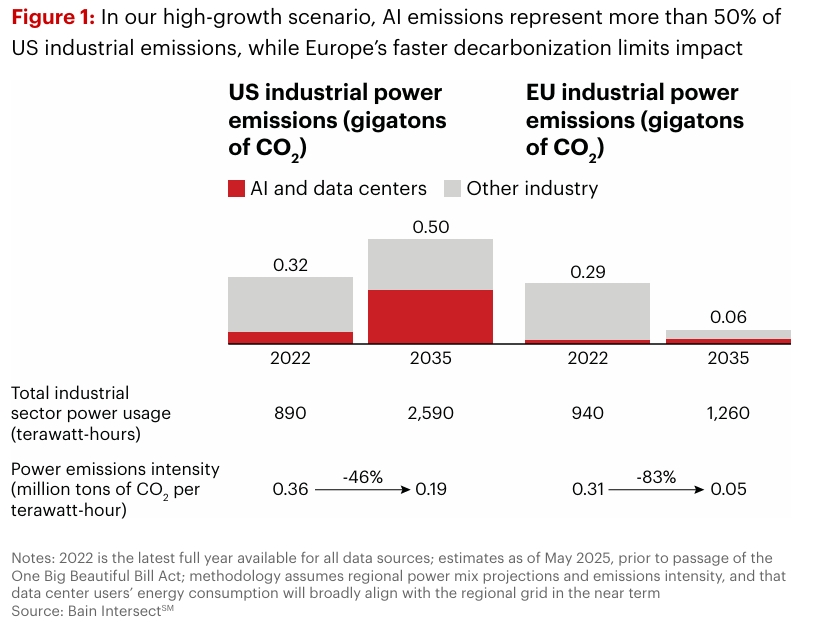
Bain’s climate-economic modeling tool, Intersect™, reveals a critical double-edged sword. In a high-growth scenario:
- AI and data centers could emit 810 million metric tons of CO₂ annually by 2035—canceling out three years of emissions cuts by the world’s 500 largest companies.
- In the US, AI could drive over 50% of industrial emissions by 2035, while Europe’s greener grid limits its impact.
Furthermore, AI is decoupling revenue from workforce growth, reshaping the future of work faster than most organizations can handle.
The “Shapers”: A Blueprint for Sustainable AI
Bain identifies a group of leaders, “Shapers” (20% of companies), who are capturing nearly twice the value from AI. Their secret? They don’t just lead in sustainability; they lead in AI.
What Shapers Do Differently:
- They Move Beyond Compliance: Shapers prioritize high-impact, long-term AI use cases:
- Long-term scenario and risk modeling for climate and geopolitics.
- Sustainable product and service design using generative AI and digital twins.
- Energy efficiency through real-time monitoring and optimization.
- Green market opportunity identification by analyzing customer data.
- They Proactively Manage Risk: Shapers are four times more likely to perceive AI’s sustainability risks. They look beyond compliance to emerging threats like talent disruption and employee trust, hardwiring sustainability into AI governance.
- They Build an Integrated Operating System: Shapers go beyond basic data infrastructure to create a holistic system:
- Program the Core Logic: Link AI initiatives to material ESG topics and choose energy-efficient models.
- Configure for Users: Upskill employees and involve them in AI role planning to build trust.
- Expand the Network: Build external coalitions with startups and policymakers to accelerate innovation.
Building Climate Resilience: The CEO Playbook for Adaptation
Decarbonization is only half the battle. Even with aggressive emissions cuts, companies face the harsh realities of a warmer world. Bain’s analysis shows only 25% of emissions can be abated profitably today. The rest represent a vast “emissions gap,” making climate adaptation not just necessary, but inevitable.
The Costs of Inaction Are Already Here:
- Broken Supply Chains: Droughts disrupting critical river trade routes in Europe.
- Increasing Scarcity: Cocoa prices tripling since 2022 due to climate-related yield declines.
- Lost Productivity: Extreme heat causing 20-30% drops in labor productivity in some regions.
- Exiting Insurers: Large areas becoming uninsurable, with $263 billion in disaster losses going uninsured in 2024.
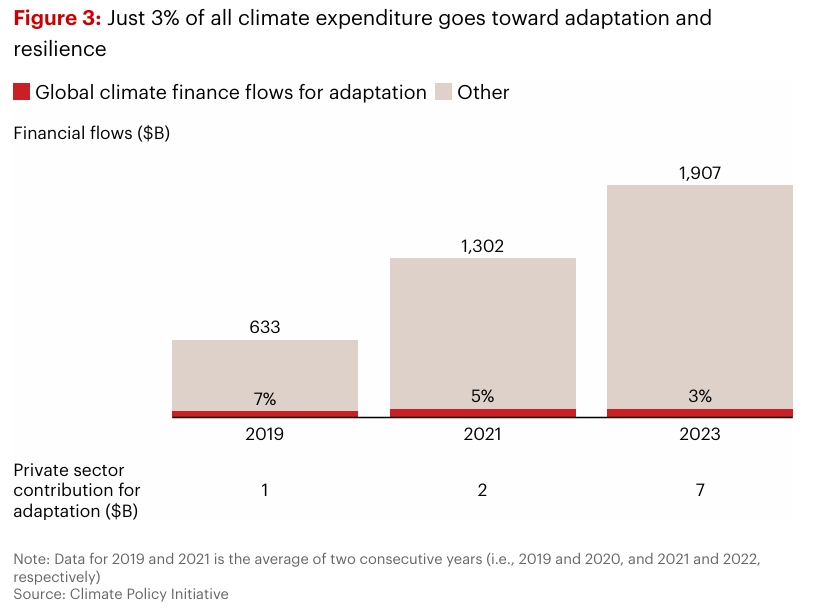
Despite operations executives ranking “increased resilience” as a top strategic priority, a mere 3% of all climate capital expenditure is directed toward adaptation.
Breaking the Preparedness Paradox:
Leaders overcome this inertia by focusing on three areas:
- Focus Where It Counts: Use advanced analytics, AI, and digital twins to conduct structured scans of climate risk across operations and supply chains. This visibility can also reveal new opportunities, such as a global insurer turning its risk data into a lucrative resilience consulting service.
- Design for Robustness: Move beyond efficiency-driven levers (automation) and embrace biological principles: redundancy (safety stock, dual sourcing), modularity (flexible manufacturing), and decentralization. It’s about strategic buffering, not waste.
- Build Resilience Governance That Works: Appoint a Chief Resilience Officer or a cross-functional council with the authority to translate climate risk into concrete investment decisions. Integrate adaptation metrics into executive dashboards and capital planning processes.
Private Equity’s Pragmatic Path to Decarbonization
The private equity world is making significant, tangible progress. From 2021 to 2023, the number of PE-owned companies disclosing through CDP jumped 55%. The results are impressive:
- Median 5% decrease in Scope 1 emissions.
- Median 26% drop in Scope 2 emissions.
These companies are translating progress into business benefits: operational efficiency, lower carbon taxes, and improved customer offerings. Scope 3 emissions remain a challenge, rising 15%, partly due to better disclosure.
The Five Practices of Decarbonization Leaders in PE:
- Focus on Both Business Value and Climate Impact: Integrate decarbonization into the core operating model. Companies with initiatives to reduce fugitive emissions achieved a median reduction of 52 tons per million dollars of revenue.
- Set Science-Based, Absolute Targets: Companies with long-term, absolute targets outperform those with short-term or intensity-based goals.
- Assign Explicit Goals to Operational Leaders: Accountability at the operational level is key, supported by high-level sponsorship (e.g., tying 10% of C-suite bonuses to sustainability).
- Collaborate Across Supply Chains on Scope 3: 92% of top-quartile manufacturers are working with suppliers to abate emissions.
- Integrate Climate Risk into Holistic Risk Management: One portfolio company, Constantia Flexibles, built a floodwall that successfully protected a plant during a major 2024 flood, minimizing operational disruption.
Transitions: The Frontiers of Sustainable Value
Bain’s report highlights three critical transitions that will define the next wave of sustainable business.
1. The Imperative of Carbon Removal Markets
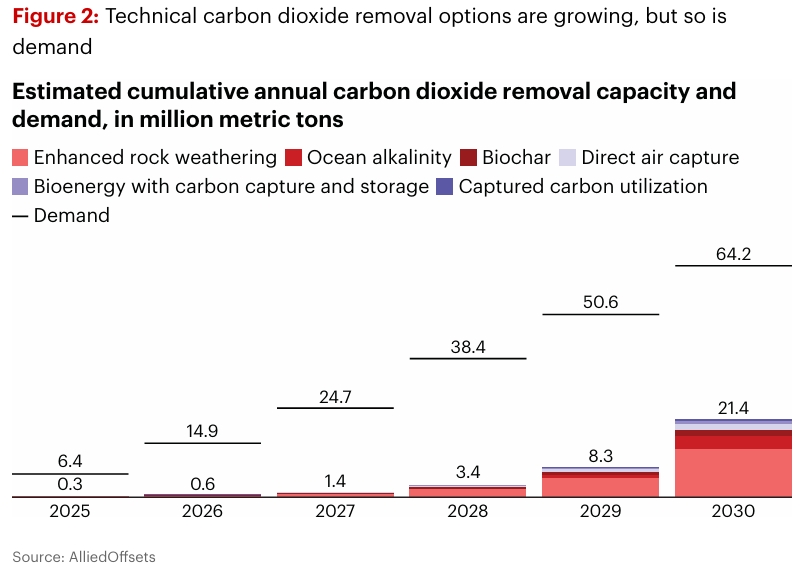
Companies cannot reach 2050 net-zero without durable carbon dioxide removals (CDRs). The math is simple: demand already outstrips supply, and CDRs need to scale nearly 5,000 times to meet current net-zero projections.
The Value of Acting Now:
- Foundational: Build knowledge to maximize future investment value.
- Short-Term: Unlock sales of green products (e.g., net-zero concrete using CDRs).
- Medium-Term: Hedge against price inflation by signing multiyear offtake agreements.
- Long-Term: Enhance the credibility of net-zero claims.
CEO Action: Develop a climate transition plan, get explicit about carbon credit needs, and secure long-term access to high-integrity CDRs.
2. Circular Business Models Unlock New Profit and Growth
Circularity is no longer just about waste reduction. A Bain/World Economic Forum survey found that 97% of businesses implement circular solutions for profitability and competitive advantage.
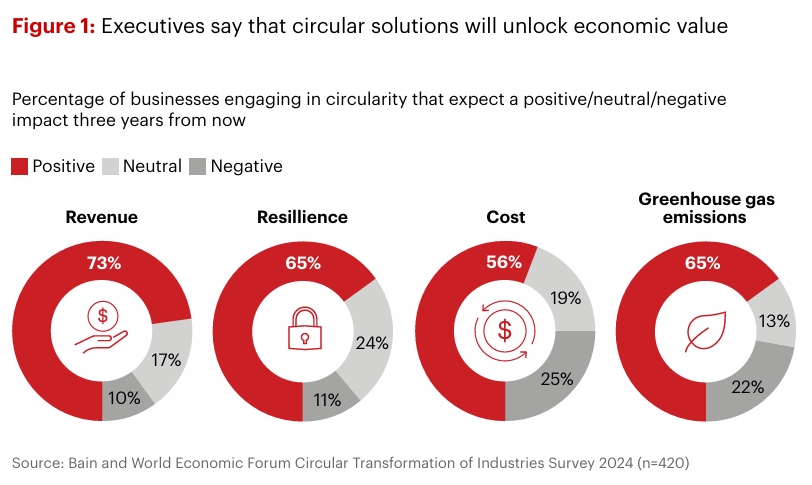
- 73% expect circular solutions to increase revenue by 2027.
- 65% believe it will improve operational resilience.
Three Paths to Circular Value:
- Circular Feedstocks: Hydro’s recycled aluminum uses 95% less energy, commands a premium, and is a cornerstone of its growth strategy.
- Extending Product Lifespans: Cisco’s modular routers and Siemens Mobility’s predictive maintenance for trains create new service revenue and strengthen customer loyalty.
- Capacity-Sharing: Trane Technologies’ rental model for HVAC units reduces customer CAPEX and creates a new, resilient revenue stream.
3. Can Food Companies Unwrap a New Strategy?
The packaged food sector is in turmoil, with shareholder returns plummeting from 15% a decade ago to just 2.9% today. Bain identifies five structural, not cyclical, disruptors: health consciousness, climate disruption, information transparency, food tech, and geopolitics.
The Three Strategic Imperatives for Food:
- Future-Proof the Business: Model the impact of climate, GLP-1 drugs, and regulation on your portfolio.
- Make the Core Relevant Again: Reinvigorate legacy categories by meeting modern health and taste demands, as Chobani did with Greek yogurt.
- Lead in the Critical Categories of the Future: Focus on six emerging trends: food-as-medicine, guilt-free indulgence, low-effort/high-reward meals, AI-powered convenience, smart nutrition, and climate-adaptive ingredients.
Conclusion: The Pragmatic Path Forward
The era of sustainability as a vague aspiration is over. The 2025 agenda, as laid out by Bain & Company, is one of pragmatic, value-driven action. The leaders of tomorrow will be those who:
- Accelerate what already works, scaling ROI-positive levers today.
- Anticipate disruption, building the agility to capitalize on policy and technology inflection points.
- Build robust, resilient systems that can withstand the shocks of a volatile world.
- Close the gaps for consumers and B2B customers by erasing trade-offs and providing transparent solutions.
- Harness AI as a strategic tool while meticulously managing its costs and risks.
- Embrace transitions in carbon removal, circularity, and food systems as the new frontiers of growth.
The journey to 2030 is not a sustainability project; it is the business strategy itself. The power of pragmatism is the power to build a business that is not only greener but also more profitable, resilient, and prepared to lead in the decades to come. The time for quiet, decisive action is now.
🔗 Links for More:
Read the full report on Bain website or NeoForm LinkedIn page.
📌 About NeoForm:
At NeoForm Business Partners, we empower enterprises to maximize sustainable growth and profitability through financial efficiency & agility and manage internal and environmental risks with our transformational services and strategic finance business partnering.
Visit NeoForm blog for more insights on global business trends.
🔗 Related Readings:
- The Next Big Arenas of Competition: 18 Super High Growth Sectors Shaping the Future Economy
- The Great Trade Rearrangement: McKinsey Insights for Global Supply Chain
- Private Equity Market Trends in 2025: A Year of Recovery and Strategic Shifts
- McKinsey Technology Trends 2025: What Is Crucial to Align Your Business
- McKinsey Global Private Markets Report 2025
NeoForm helps visionary leaders translate sustainability ambition into tangible business value. Our expertise in strategy, financial & operational transformation, and ESG integration can help you build the robust, pragmatic, and high-growth company of the future. Explore NEO Services or Contact us today to learn how we can help you build a resilient, rearranged, and future-proofed strategy.
2 Comments
Bain Technology Report 2025: AI is Dividing Leaders - NeoForm Business Partners
[…] Turning Sustainability into Growth: The Pragmatist’s Playbook for&nb… […]
Innovation Strategy Trends: How Bold Companies Scale Big Ideas in 2025 - NeoForm Business Partners
[…] Turning Sustainability into Growth: The Pragmatist’s Playbook for&nb… […]