


The Future of Financial Planning is Autonomous: Are You Ready?
For decades, the financial planning and analysis (FP&A) process has been a ritual of corporate life: a slow, rigid, and often painful cycle of chasing inputs, wrestling with spreadsheets, and producing forecasts that are outdated almost as soon as they’re published. But there is an opportunity for change in FP&A in the era of AI agents.
What if your finance system could do more? What if you could simply ask it, in plain English, to update your Q4 forecast based on the latest market data and receive a fully modeled, risk-adjusted answer in minutes?
According to groundbreaking insights from Bain & Company, this isn’t a distant vision of the future. The era of autonomous financial planning is emerging now.
The Breaking Point: Why FP&A Needs Transformation with AI Agents
Legacy budgeting systems are fundamentally ill-suited for today’s volatile economy. Inflation shocks, supply chain disruptions, and rapidly changing customer preferences expose the critical flaw in rigid, calendar-based planning.
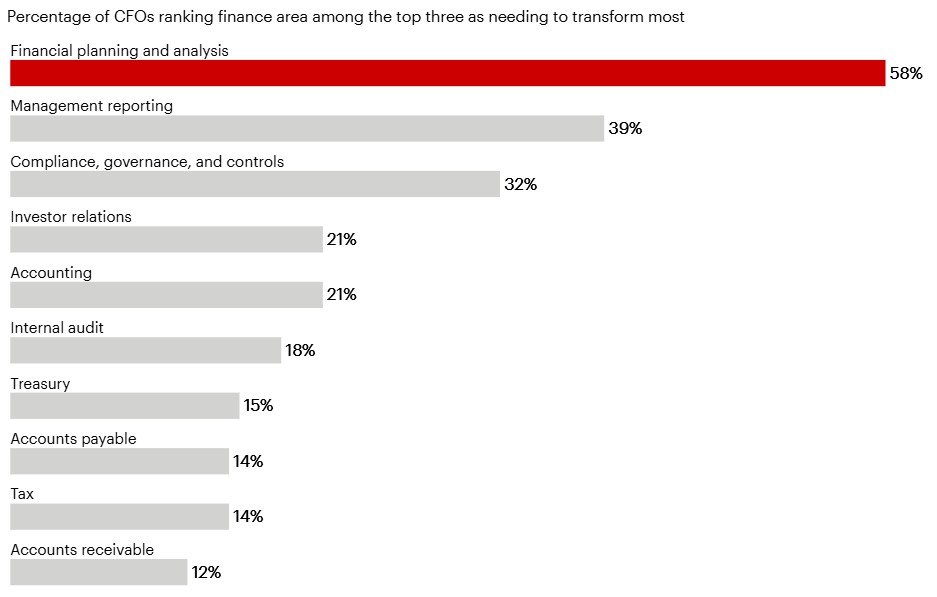
The data confirms this pain point. Bain’s 2024 CFO Survey reveals that FP&A is the number one area in finance that needs transformation, ranked ahead of compliance, reporting, and accounting.
The consequence of outdated processes is stark. Bain’s research shows that only 13% of finance teams consistently lead in the five key attributes needed for modern volatility: accuracy, timeliness, flexibility, innovation, and value/cost. The rest are trapped in a cycle where FP&A professionals spend 65% of their time on data collection and cleaning instead of generating strategic business insights.

The AI Arsenal in Finance: Generative and Agentic AI Join the FP&A
AI transformation in FP&A has two powerful drivers:
- Generative AI helps humans interpret and interact with data.
- Agentic AI makes decisions based on data and manages systems autonomously.
While machine learning (ML) has been a first step for many—with 28% of finance teams using ML in quarterly planning—it has limits. It requires heavy tuning, structured data, and constant oversight.
Generative and Agentic AI are change the game in finance and FP&A.
The Power of Generative AI in Finance
Imagine a financial analyst wondering why Q3 revenue is projected to fall. Instead of digging through countless spreadsheets, they can ask an AI interface a simple question and get a plain-language answer that explains the model’s assumptions and the influencing factors.
Generative AI excels at:
- Synthesizing Unstructured Data: It turns messy text from news, reviews, and internal messages into forecasting-ready variables in minutes.
- Explainability: Tools like retrieval-augmented generation (RAG) build trust by making AI-driven forecasts interpretable.
- Interactive Scenario Planning: Users can ask “what if” questions—like “What happens if we reduce marketing by 10%?”—and AI gives them real-time modeled outcomes, transforming planning into a continuous, collaborative process.
The Rise of AI Agents in FP&A: Your Autonomous Finance Team
If Generative AI is the brain, Agentic AI is the hands. These are not just copilots; they are autonomous systems that manage entire workflows.
Take Microsoft as a prime example. Within its finance organization:
- Forecasting Agents have replaced Excel-based modeling with a no-code ML platform.
- Reconciliation Agents automatically match financial records, reducing cycle time from hours to minutes.
- Analyst Agents interpret variance causes, build visual dashboards, and draft executive narratives.
These agents are deeply embedded into Microsoft 365, allowing analysts to access forecasts, run simulations, and generate reports directly within Excel, Teams, and Outlook. This represents a scalable model of agentic finance in action.
The Path to Modernization of FP&A with AI Agents
How can your organization begin this journey? Bain outlines three distinct approaches to modernizing your FP&A function.
1. Streamlining: Build a Solid Foundation
Before layering on intelligence, you need unified, trustworthy data. Streamlining focuses on simplifying processes, sequencing tasks logically, and introducing automation for repetitive tasks like reconciliations.
Case in Point: Global power management company Eaton integrated data from 72 different ERP systems using Palantir’s AI platform. This created a single source of truth, providing real-time supply chain insights that enabled faster, more accurate decisions in both production and financial planning.
2. Enhancing: Supercharge Insights with AI
This step involves layering AI—especially Generative AI—onto a solid data foundation to gain richer insights and faster feedback.
Case in Point: A global consumer products company used traditional ML to cut revenue forecast preparation time from two weeks to two hours, with accuracy rising above 97%. They are now exploring Generative AI to simulate scenarios and auto-generate narrative reports.
3. Reinventing: Rethink the Operating Model
This is the most transformative approach. It involves moving away from fixed annual budgets altogether in favor of rolling forecasts and event-triggered planning.
Case in Point: Hilti replaced static budgets with three rolling forecasts per year and tied its bonus system to external benchmarks, not internal targets. This human-led but highly responsive system, redesigned back in 2006, allows the company to adapt swiftly to any market condition, proving that agility is as much about process as it is about technology.
The Human Factor: Augmented Intelligence, Not Unchecked Automation
It’s crucial to understand that autonomy does not mean human abdication. As AI scales, governance around data provenance, model oversight, and decision accountability becomes more essential than ever. The goal is augmented intelligence—using AI to empower your finance team to focus on high-value strategic work, not administrative tasks.
Reshape Your Finance Function, or Get Left Behind
The gap is widening. On one side are companies stuck in rigid, calendar-based cycles. On the other are leaders who are experimenting boldly with AI, designing their financial systems for adaptability and real-time response.
The question is no longer if autonomous finance is the future, but how quickly your organization can rewire its planning approach to harness its full power. The leaders who act now will be the ones defining finance’s next decade.
🔗 Links for More:
Read the original article on Bain website or NeoForm LinkedIn page.
📌 About NeoForm:
NeoForm Business Partners is a strategic and transformational partner specialized in Financial Transformation through financial efficiency and agility. At NeoForm, we partner with businesses to implement cutting-edge Intelligent Planning & Analysis solutions that drive smarter decisions and better outcomes.
Visit our blog for more insights on financial planning, budgeting & transformation.
🔗 Related Readings:
- Financial Planning is Dead – Long Live Agile Financial Planning!
- FP&A Best Practices: Top 10 Principles of Effective Budgeting & Forecasting
- FP&A Transformation: Unlocking the Billion-Dollar Opportunity for Your Business
- How to Build a Dynamic Budget for an Era of Accelerating Uncertainty
- 5 Ways to Transform Annual Planning & Budget to Worth the Effort
Is your organization ready to embrace AI agents and transform its financial & business planning capabilities? Explore NEO Services and Contact NeoForm today to learn how our expertise and technology solutions can help you transform and future-proof your planning processes.