


Cost Transformation 2025: It’s Not About Cutting. It’s About Building.
For years, “Cost Transformation” has been a boardroom buzzword, often synonymous with layoffs, budget freezes, and a general atmosphere of austerity. These traditional, slash-and-burn exercises provide a short-term financial bump, but a sobering statistic from Boston Consulting Group (BCG) reveals their true legacy: a staggering 75% of cost programs fail to hit their long-term goals.
Why? Because costs creep back and they demoralize the workforce. Because they often starve the very engines of future growth—innovation, talent, and digital capability.
The game has changed. In today’s volatile economic landscape, marked by inflation, geopolitical shifts, and technological disruption, a new paradigm for cost management is emerging. Based on BCG’s latest research, successful cost transformation in 2025 is no longer a defensive, one-time project. It is a continuous, strategic, and holistic effort to fundamentally redesign your company’s cost structure to fuel growth, improve competitiveness, and increase financial resilience.
At NeoForm, we partner with leaders to translate this strategic vision into operational reality. This article delves into the core insights from BCG’s 2025 outlook, providing a roadmap for a transformation that doesn’t just save money—it builds a stronger, more agile, and more profitable company.
What is Cost Transformation, Really? A Foundation for Growth
Let’s dismantle the old definition first. Cost transformation is not simply cost-cutting.
It is a strategic, holistic, and continuous effort to fundamentally redesign a company’s cost structure, enabling it to fund growth initiatives, improve competitiveness, and increase financial resilience. It goes beyond temporary reductions to embed efficiency and fiscal discipline into the company’s very culture and operating model.
BCG outlines several core philosophies that underpin this modern approach:
- Strategic Imperative, Not Tactical Cutting: Every dollar saved should be a dollar strategically reallocated. Transformation must be linked to business strategy—funding R&D, digital transformation, or entering new markets. It’s about spending smarter, not just spending less.
- Sustainable Efficiency: The goal is a permanently lower, agile cost base, avoiding the negative impacts of one-off cuts that never stick.
- Zero-Based Mindset (ZBB): This is a principle of justifying all expenses for each new period from a “zero base,” challenging legacy spending and instilling discipline. It’s a mindset, not just a budgeting tool.
- Value-Driven: Efforts are prioritized based on where they create the most value for customers and shareholders, systematically eliminating low-value activities.
This foundational philosophy sets the stage for the powerful methodologies and levers that drive successful transformation.
The Dual Mandate: You Don’t Have to Choose Between Growth and Cost Reduction
One of the most powerful insights from BCG is the rejection of a false choice. The most successful companies don’t choose between reducing costs and growing revenue; they do both simultaneously.
BCG analysis of over 1,000 companies shows that for more than a third, costs are growing faster than revenue, relentlessly eroding profitability. Traditional cost-cutting provides short-term relief, but costs often creep back, weakening the company’s ability to invest in its future.
The answer? Launch transformations with a dual mandate: reduce costs while turbocharging revenue growth. This isn’t a contradiction; it’s a strategy. The savings from one fund the investments for the other.
Cost Transformation for Growth
BCG identifies three core principles for achieving this balance:
- Go Big and Go Fast: Bold, ambitious targets set from the top are crucial. High-performing organizations are 80% more likely to have senior leaders directly communicate transformation ambitions. Moving quickly—delivering 20-40% of target value in the first year—generates crucial financial “oxygen,” builds momentum, creates early wins, and overcomes internal resistance.
- Set Clear Boundaries Between Cost and Growth: A common pitfall is blurring the lines between savings and reinvestment. Without clear separation, savings are often reinvested prematurely or without impact. High performers draw a hard line, managing both with equal diligence. They establish dedicated governance (e.g., an investment board) to ensure freed-up resources are allocated to the highest-return opportunities, like AI or innovation.
- Ensure Lasting Results Through Organizational Change: Delivering results is only half the battle; sustaining them is the real challenge. Long-term winners embed financial discipline through structural changes that remove work, not just redistribute it. They implement robust performance management systems, linking incentives to personal success metrics (increasing success likelihood by 40%).
This structured approach ensures transformation is a journey of building, not just breaking down.
The Zero-Based Organization: A Methodology for Strategic Reinvestment
A key methodology for executing this dual mandate is the Zero-Based Organization (ZBO) approach. Unlike across-the-board “haircuts,” ZBO is a collaborative, bottom-up process for reviewing people and people-related costs. It involves:
- Setting a cost baseline for each activity from scratch.
- Pinpointing the company’s strategic ambition.
- Creating a “Minimum Viable Product” (MVP) for each service.
- Challenging the resource baseline with cross-functional teams.
This makes managers agents of change, invested in cost consciousness. The result? Sustainable change that frees up funds for strategic bets—like hiring AI talent—rather than sacrificing them.
BCG cites a large European utility conglomerate that used ZBO to fund its shift from nuclear power to renewables. By reimagining support functions like HR, IT, and Finance, they achieved a 19% savings in HR, which was then reinvested in strategic activities like workforce planning and learning & development for new capabilities.
Confronting the Four Evergreen Organizational Cost Challenges
Most cost programs fail because they don’t address the underlying organizational dynamics that cause cost creep in the first place. BCG’s research identifies four pervasive challenges that must be tackled head-on for lasting success:
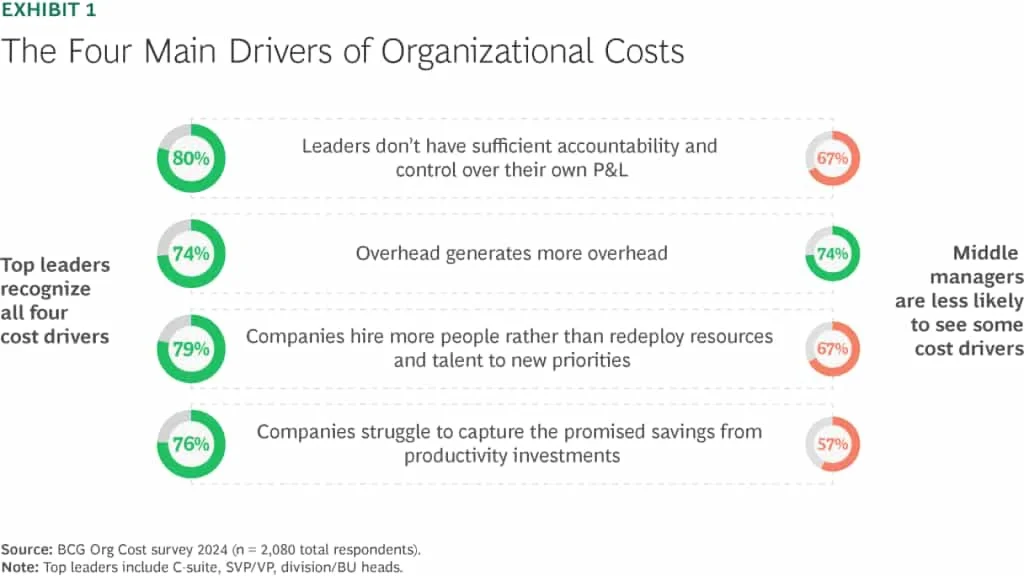
- Lack of P&L Accountability (Cited by 80% of leaders): When leaders don’t have direct responsibility for their P&L, cost becomes “someone else’s problem.” Solution: Redesign operating models to assign clear P&L accountability and strong incentives.
- Overhead Generates Overhead (74%): Support functions naturally become inflated and bureaucratic over time. Solution: Aggressively cut bureaucracy, increase managers’ spans of control, and thin out layers of middle management.
- Hiring vs. Redeploying (79%): The impulse is to create new roles for new priorities rather than repurpose existing ones. Solution: Revamp governance to make it easier to shift resources to higher-priority areas and invest in upskilling.
- Failing to Capture Productivity Savings (76%): Investments in digital and AI often don’t translate into a leaner organization because leaders don’t eliminate superfluous positions. Solution: Redesign processes and roles to incorporate new tech and develop concrete plans to capture hard savings.
Companies that address all four of these challenges simultaneously create a powerful multiplier effect, significantly improving their odds of building a lasting cost-capable organization.
The Human Element: The Cost Transformation Essential You’re Probably Missing
An often-overlooked pillar of success is the emotional strength of your workforce. Turbulent transformations create fear, anxiety, and uncertainty, which can paralyze even the most well-conceived strategies.
- Clarity: People need to understand the issue and the required actions.
- Trust: They must believe leaders have their best interests at heart.
- Meaning: They need to feel their work contributes to a worthwhile cause.
- Belonging: They must feel accepted and part of a group.
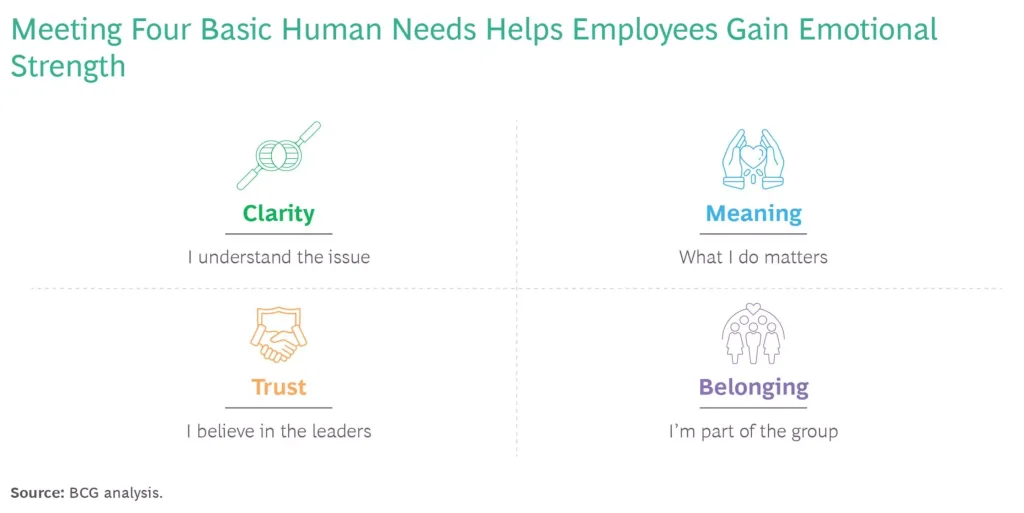
Companies that proactively instill resilience by connecting the transformation to purpose, vision, and values see less performance drop from external shocks, faster recovery times, and better overall outcomes. This isn’t “soft” stuff—it’s a hard-edged strategy for maintaining productivity and retaining top talent during disruptive change.
Making It Count: Bridging the Gap to the Bottom Line
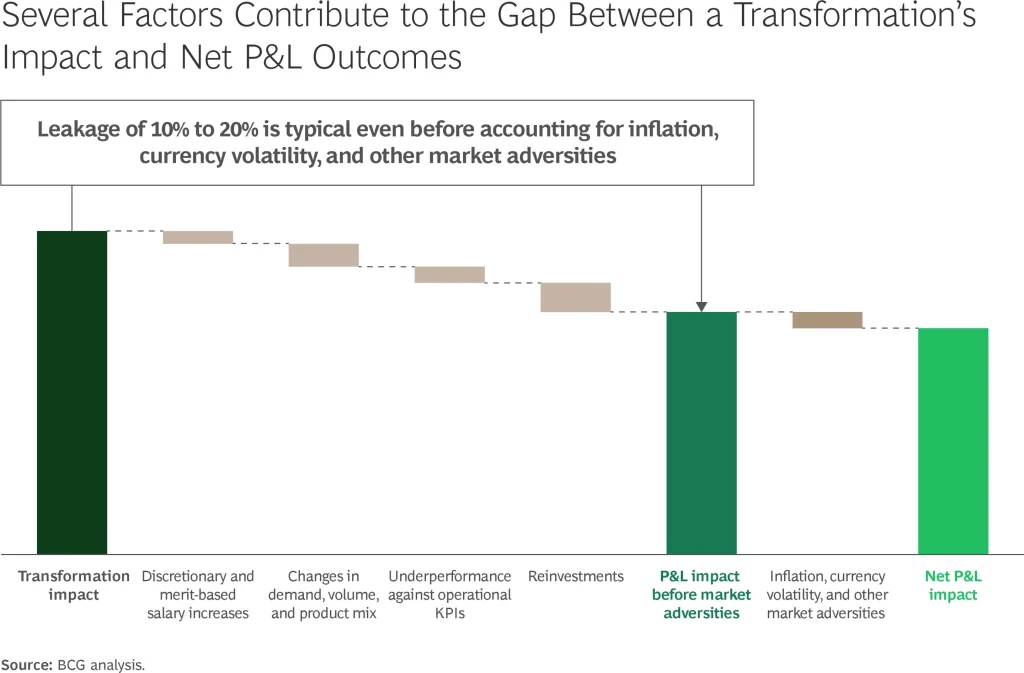
A transformation’s success is ultimately judged by its impact on shareholder value. However, BCG identifies a critical issue: leakage. Even well-planned transformations can see 10-20% of their expected financial impact erode before it reaches the P&L due to factors like:
- Discretionary salary increases
- Changes in demand, volume, and product mix
- Underperformance against operational KPIs
- Strategic reinvestments
- Inflation and currency volatility
To combat this, leaders must apply disciplined financial oversight:
- Partner with Finance to build a robust methodology for tracking impact.
- Build Infrastructure to track net P&L delivery, not just gross savings.
- Cascade Awareness to drive accountability throughout the organization.
- Align Incentives with net P&L impact, not just project completion.
- Embed a Value-Driven Culture to sustain impact long after the program ends.
The NeoForm Perspective: Your Partner in Cost Transformation
The insights from BCG’s 2025 collection paint a clear picture: the future of cost management is strategic, holistic, and human-centric. It requires moving beyond isolated tactics to a programmatic approach that builds lasting capability.
At NeoForm, this philosophy is at the core of what we do. We are not just consultants; we are Transformational CFO Service Providers and Strategic Finance Business Partners with skin in the game. We help you:
- Define Your Ambition: Move beyond narrow cost targets to a holistic vision that links savings to growth funding.
- Execute with Precision: Implement ZBO mindsets, tackle the four evergreen cost challenges, and leverage key operational levers in supply chain, procurement, and productivity.
- Manage Change: Build an emotionally resilient workforce by fostering clarity, trust, meaning, and belonging.
- Govern for Value: Establish rigorous tracking and governance to ensure savings materialize on your bottom line.
The companies that will win in 2025 and beyond are those that see cost transformation not as a painful necessity, but as a unique opportunity to shed legacy inefficiencies, reinvest in their future, and build a fundamentally stronger, more agile, and more competitive organization.
🔗 Links for More:
Download and read the full collection from link below or NeoForm LinkedIn page.
📌 About NeoForm:
NeoForm Business Partners is a strategic and transformational partner specialized in Financial Transformation through financial efficiency and agility.
Check NeoForm blog for more insights on Financial Transformation:
- Efficient Growth: Key Lessons for CFOs from Top Performers
- Rescuing the Decade: Transforming Consumer Goods Industry
- Balance Sheet Optimization to Unlock Hidden Profit Trapped in
- Unlocking Long-Term Resilience in Banking: The CFO’s Strategic Role
- Unlocking Financial Transformation: How Optimizing Working Capital Drives Early Momentum
Ready to transform your cost structure into a growth engine? Let’s talk.
Contact NeoForm Today to begin your journey toward sustainable, strategic reinvention.
3 Comments
6 Human-centric Levers for Any CFO to Turn Transformations into Success - NeoForm Business Partners
[…] Cost Transformation 2025: Beyond Cutting to Strategic Reinvention […]
Finance Trends 2026: How CFOs Can Move From Stewards to Strategists - NeoForm Business Partners
[…] Cost Transformation 2025: Beyond Cutting to Strategic Reinvention […]
Financial Performance Transformation: How CFOs Balance Risk, Innovation & Value - NeoForm Business Partners
[…] Cost Transformation 2025: Beyond Cutting to Strategic Reinvention […]