

The 2025 B2B Sales Growth Blueprint: Decoding the Moves That Separate Winners from Laggards
The playing field for B2B sales growth in 2025 is both exhilarating and daunting. After a strong performance in 2024, with over half of companies exceeding growth targets, the bar has been raised. Ambition is high, with firms expecting an average of 1.3x revenue growth this year.
But beneath this surface of optimism, a fierce divide is emerging.
According to Bain & Company‘s comprehensive Commercial Excellence and Revenue Growth Agenda 2025 report, which surveyed over 1,300 senior commercial executives, a distinct class of “winners” is pulling away from the pack. These companies aren’t just growing; they are lapping their competition, delivering twice the average revenue growth of their respective industries.
What is their secret? It’s not a single magic bullet, but a disciplined, integrated agenda built on four powerful pillars:
- Scaling AI beyond pilots to become a true “force multiplier.”
- Executing a targeted, repeatable Sales Play System™.
- Expanding profit margins through intelligent, dynamic pricing.
- Investing in long-term commercial productivity with a multi-year horizon.
At NeoForm, we understand that transforming these insights into action is the real challenge. This deep dive into Bain’s report will unpack the data, reveal the strategies of top performers, and provide a actionable blueprint for your revenue growth in 2025 and beyond.
The Great B2B Sales Growth Divide: A Tale of Two Strategies
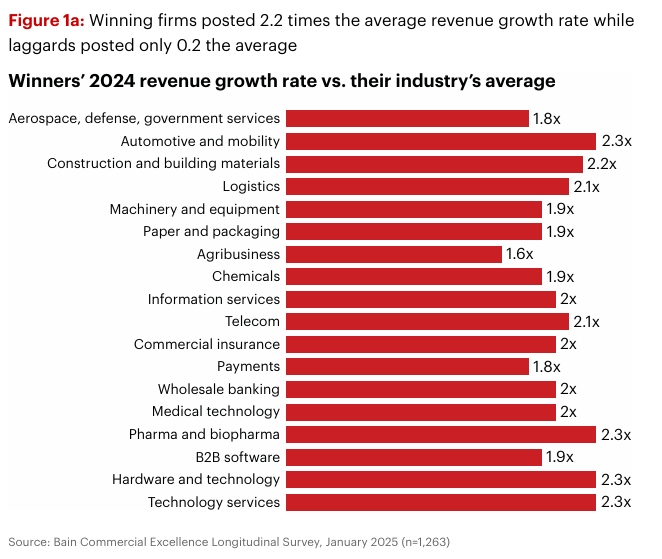
Bain’s research defines “winners” not just by revenue growth but by sustainable, profitable growth. These are companies that achieved revenue growth above the upper quartile for their sector and demonstrated positive gross margin growth in 2024. “Laggards” fell below the lower quartile in growth.
The performance gap between these two groups is staggering. Winners didn’t just slightly outperform; they achieved 2.2 times the average industry revenue growth rate. In some sectors, like Automotive, Pharma, and Hardware, this multiplier was as high as 2.3x. Meanwhile, laggards managed a meager 0.2x the average.
But past performance is only part of the story. The study reveals a fundamental divergence in mindset and focus for the year ahead.
- Winners’ Top Concern: Effectively leveraging artificial intelligence (AI) and machine learning.
- Laggards’ Top Concern: Navigating market uncertainty and managing pricing pressures.
This is a profound insight. Winners are focused on proactively shaping their future with technology. Laggards are focused on reacting to external forces. This proactive vs. reactive stance is the core of the growth divide.
The Universal Challenges: The Battlefield for 2025
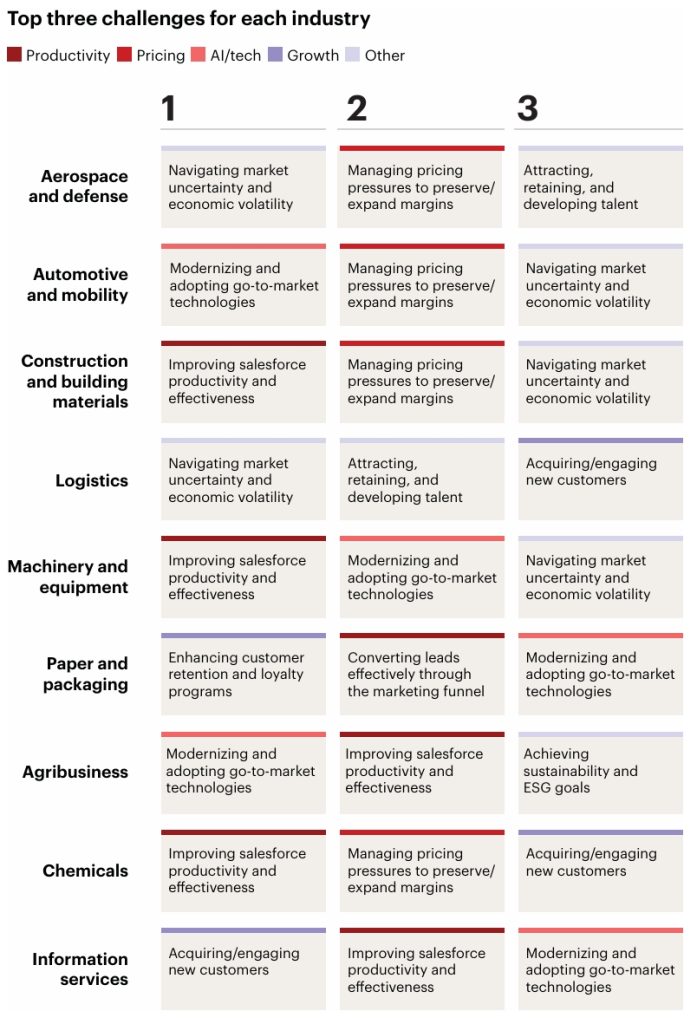
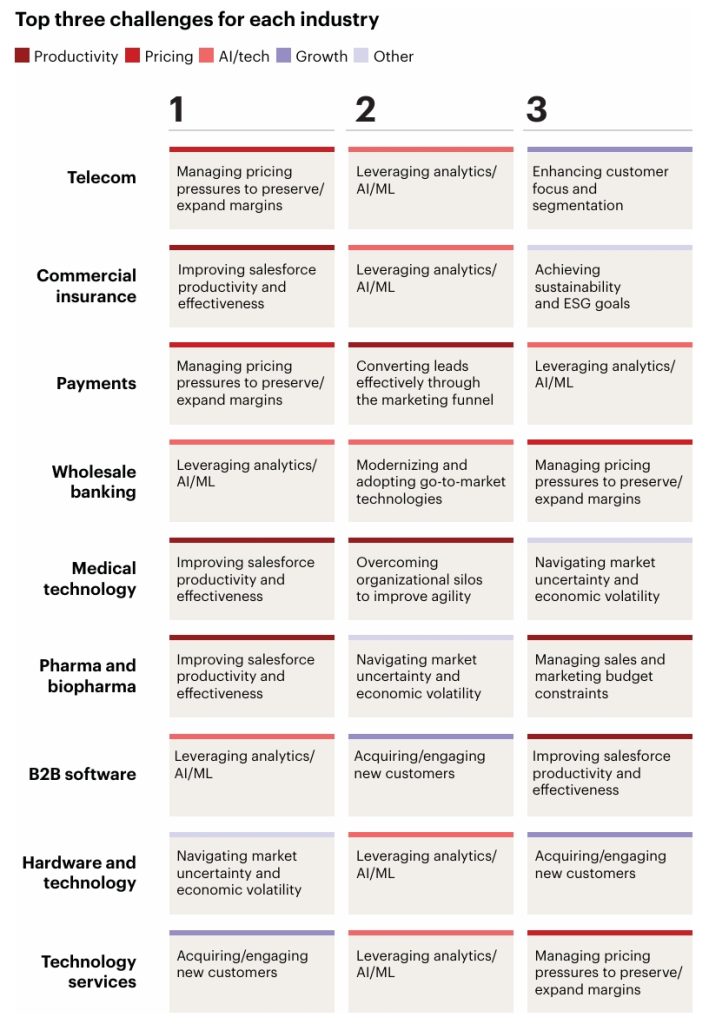
Regardless of performance, all companies face a common set of hurdles. The top challenges identified for 2025 are:
- Improving salesforce productivity and effectiveness (42%)
- Managing pricing pressures (38%)
- Leveraging analytics, AI, or machine learning effectively (37%)
- Modernizing and adopting go-to-market technologies (37%)
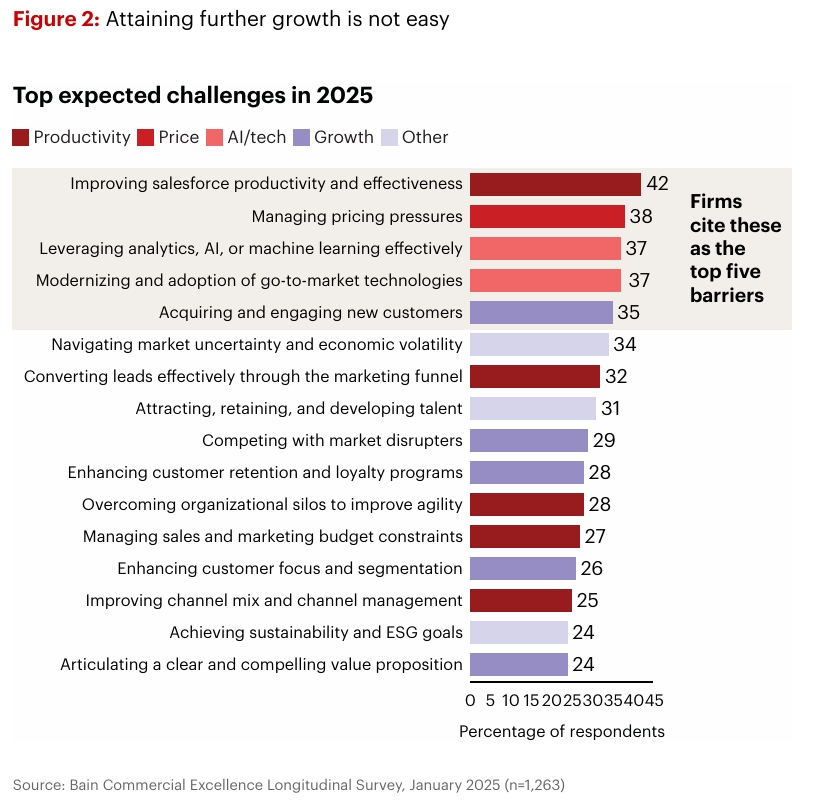
Overcoming these challenges is the key to unlocking growth. Let’s explore how the winners are doing exactly that.
Pillar 1: Parsing How Winners Use AI – Beyond the Hype to Hard Value
The conversation around AI in 2024 was largely about experimentation and pilots. In 2025, it’s about scale and value. A remarkable 90% of executives have scaled at least one AI use case. But winners are scaling an average of 4.5 use cases compared to just 3.3 for laggards.
The AI Use Case Landscape: No One-Size-Fits-All
There is no single “killer app” for AI. Its value is derived from solving industry-specific bottlenecks. Bain’s data shows widespread deployment across functions:
- Automated document preparation (42%): From tailoring RFPs in construction to customizing sales collateral in tech.
- Automated sales rep tasks (39%): Ranging from simple CRM data entry to autonomous AI development reps handling initial inbound/outbound communications.
- Sales manager and rep coaching (37%): Using AI to analyze call transcripts and provide data-driven feedback.
- Sales play creation & orchestration (36%): Identifying and scaling the most effective go-to-market motions.
- Intelligent pricing (34%): Using AI for strategic price setting, discounting, and getting.
The key is strategic selection. A tech company might use AI for hyper-personalized marketing, while a logistics firm uses it for dynamic price strategy.
The Winners’ AI Advantage: Investment and Integration
Why do winners see nearly 2x greater cost efficiencies from each AI use case? The answer lies in foundation and investment.
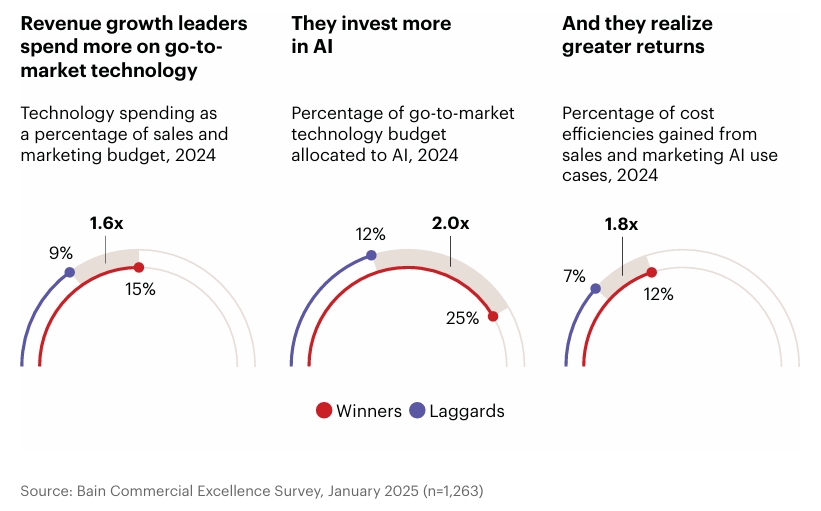
- They Spend More: Winners allocate a larger portion of their sales and marketing budget to technology (9% vs. 7% for laggards) and dedicate more of that tech budget specifically to AI (15% vs. 12%).
- They Build Better Foundations: Winners avoid the most common pitfalls that plague AI initiatives. Over 47% of companies cite “incomplete or low-quality data” as a top challenge, while 44% struggle with “technology not correctly configured.” Winners prioritize a unified customer profile and integrated tech stack from the outset.
- They Manage Change Systematically: Winners adhere to more best practices: securing executive sponsorship, building robust business cases, and investing in frontline training. Companies following four or more best practices realized 12% cost efficiency vs. just 5% for those following none.
The NeoForm Perspective: AI is not a plug-and-play solution. Its value is unlocked through intentional architecture. At NeoForm, we help clients build the data foundation and integration layer that turns disparate AI tools into a cohesive, value-generating system. It’s about creating a single source of truth that empowers AI, rather than creating more data silos.
Pillar 2: Igniting 2x More Growth with a Sales Play System™
Perhaps one of the most telling stats in the entire report is this: while 82% of companies claim to run sales plays, only 21% realize their full value. This “sales play gap” represents one of the largest untapped opportunities for B2B growth.
What is a Real Sales Play System™?
A sales play is not a one-off piece of collateral or a single campaign. Bain defines a true Sales Play System™ as a targeted, repeatable go-to-market motion that is coordinated across sales, marketing, and product groups. It’s a standardized yet adaptable recipe for capturing value in a specific market segment or with a specific customer profile.
Companies that executed a genuine system posted 2.2 times the average growth rates versus those that did not.
The Six Keys to Unlocking Full Value
Bain identifies six best practices that separate sales play success from failure. Winners execute on multiple fronts:
- Aligning coverage to addressable spending: Using data to focus efforts on accounts with the highest likelihood to buy and the largest spending potential.
- Working in sync: Breaking down silos between sales, marketing, and product to ensure a unified front.
- Choosing the where and how: Prioritizing the right plays and providing real-time coaching to reps on how to run them.
- Defining value for customers: Developing a clear, compelling narrative and value proposition that justifies your price.
- Embedding technology: This is the biggest hurdle—70% of companies struggle to integrate sales plays into their revenue tech stack (CRM, MAP, etc.). Success requires seamless integration.
- Planning the script: Creating prescriptive, proactive plays with collateral tailored by customer segment, not reactive, generic documents.
The impact of layering these practices is cumulative. The data shows a direct correlation: the more best practices a company consistently executes, the higher its growth relative to the industry average.
The Generative AI Catalyst
Generative AI is set to revolutionize sales plays by mining previously inaccessible data sources (like call transcripts and email chains) for insights. It can augment go-to-market decisions with real-time intelligence, suggesting the next best action or dynamically tailoring messaging. Firms that effectively integrate this AI-driven insight into their tech stacks will dominate.
The NeoForm Perspective: A sales play is a process, not a document. Our approach involves working with clients to codify their best practices into a living system within their CRM. We focus on integration first, ensuring that plays are not a separate activity but are embedded directly into the rep’s workflow, making adoption effortless and value inevitable.
Pillar 3: Expanding Profit Margin Through Intelligent Pricing
With cost inflation stabilizing in 2024, 55% of companies were finally able to match or exceed input cost hikes with price increases. However, as the “easy” justification of inflation recedes, a new challenge emerges: how to continue margin-enhancing pricing in a more stable environment?
The Confidence Gap and the Margin Premium
The biggest barrier to strategic pricing is competitive pressure and customer resistance (67%). The next two are capability gaps: insufficient data/analytics (39%) and lack of team skills/expertise (37%).
This creates a “confidence gap.” The firms that are confident in their ability to push through price increases in 2025 expect a massive payoff: a profit margin premium of 3 to 11 percentage points over their less confident peers.
How Pricing Leaders Bridge the Gap
Leaders are attacking this problem on two fronts:
- Technology and AI for Precision: Virtually all firms are investing in AI-powered pricing tools. Leaders use these for competitor benchmarking, micro-segmenting customers for tailored pricing, and providing dynamic guidance to reps during negotiations. Bain found that sales reps with data-driven guidance were almost twice as likely to be confident in realizing price increases.
- The Value Story and Frontline Training: Technology is useless if the sales team can’t articulate the value. A stunning 52% of companies confident in raising prices plan to invest in more frontline training. The goal is to equip sellers to tell a distinctive value story that justifies a premium, moving the conversation away from price alone.
The NeoForm Perspective: Pricing power comes from perceived value. Technology provides the ability to price intelligently, but your commercial team provides the justification. We help clients align their entire GTM narrative around value, ensuring that marketing messages, sales conversations, and product delivery all reinforce why your solution is worth the price. This creates a cohesive system where pricing strategy is supported by value delivery.
Pillar 4: The Quest for Ever-Greater Efficiencies
Productivity is not about cutting costs; it’s about maximizing output from your commercial investments. Overall, 54% of B2B companies expect to improve commercial productivity in 2025, but winners approach this with a different playbook.
Where Firms Are Focusing
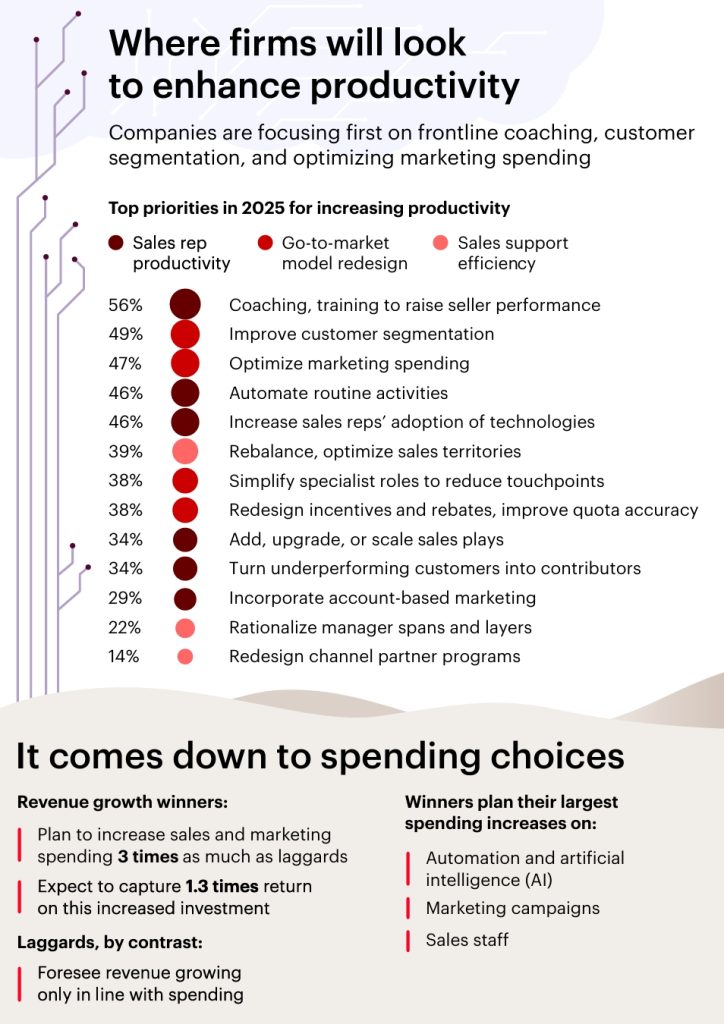
The top productivity priorities for 2025 are:
- Coaching and training to raise seller performance (56%)
- Improving customer segmentation (49%)
- Optimizing marketing spending (47%)
- Automating routine activities (46%)
The Winner’s Investment Paradox
Here’s the counterintuitive finding: Winners plan to increase their sales and marketing spending 3 times as much as laggards. But they also expect to capture 1.3 times the return on that increased investment.
How? They are not spending more on the same things. They are making strategic bets on the future:
- Automation and AI
- Marketing campaigns
- Sales staff
Laggards, by contrast, foresee revenue growing only in line with spending—a sign of stagnant productivity.
The Framework for Sustained Productivity
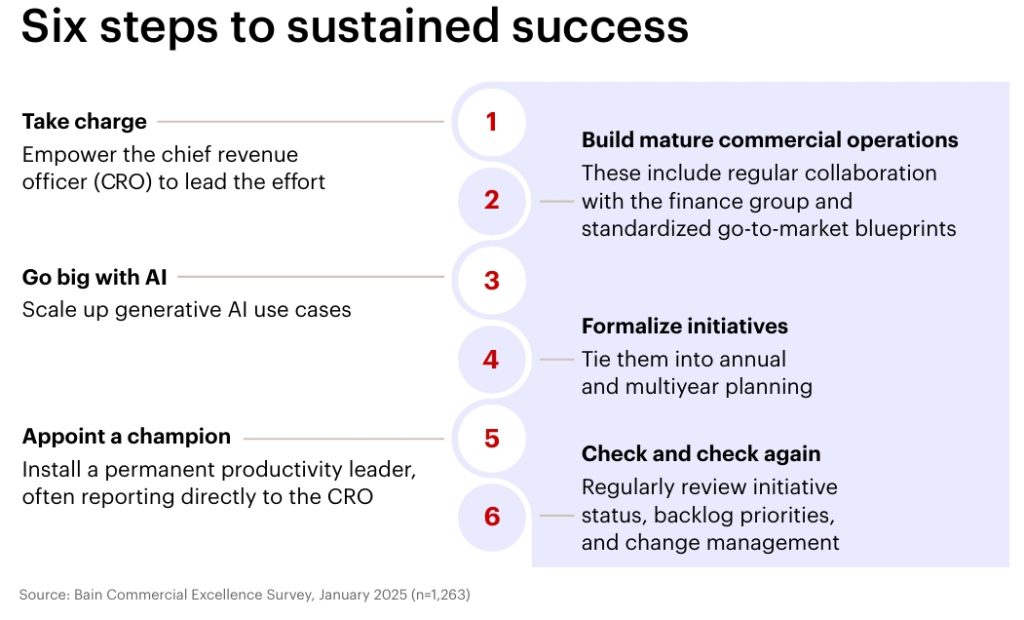
Winners don’t view productivity as an annual cost-cutting exercise. They set multi-year targets supported by dedicated initiatives. Bain outlines a path to sustained success:
- Take charge: Empower the Chief Revenue Officer (CRO) to lead the productivity effort.
- Go big with AI: Scale generative AI use cases beyond pilots.
- Appoint a champion: Install a permanent productivity leader.
- Build mature commercial operations: Standardize processes and collaborate closely with finance.
- Formalize initiatives: Tie them into annual and multi-year planning.
- Check and check again: Regularly review progress and adapt.
The 2025 Agenda: Integrating for Impact in an Age of Disruption
The overarching theme from Bain’s report is that success in 2025 hinges on integration. It’s not enough to have advanced AI, great sales plays, smart pricing, and good coaching if they operate in isolation.
The winners are building a synergistic growth engine where:
- AI powers the sales plays and provides pricing intelligence.
- Sales Plays provide the structured framework for the commercial team to execute.
- Intelligent Pricing ensures that growth is profitable.
- Productivity Investments ensure the entire system becomes more efficient over time.
As tariffs and protectionist policies add complexity to global commerce, this integrated approach provides the agility and resilience needed to navigate seismic shifts.
Your Next Move: From Insight to Action with NeoForm
The data is clear. The blueprint is defined. The question is, how do you execute?
The challenges are complex, but they all point to a common need: building a unified, data-driven, and agile commercial engine. This is where NeoForm partners with ambitious B2B companies.
We don’t just provide consultants; we provide embedded experts who help you:
- Architect Your Data Foundation: Create the unified customer profile and clean data environment that makes AI and analytics possible.
- Integrate Your Tech Stack: Break down silos between your CRM, MAP, pricing tools, and AI applications to create a seamless workflow for your revenue teams.
- Operationalize Your Sales Plays: Codify your best practices into a repeatable, measurable system that is embedded directly into your reps’ daily routine.
- Amplify Your Value Story: Align your messaging, enable your frontline, and build a commercial culture that commands premium pricing.
The growth divide is real, but it is not permanent. The moves that define winners in 2025 are knowable and achievable. Let’s discuss how you can build your own growth agenda.
🔗 Links for More:
Read the full report on Bain website or NeoForm LinkedIn page.
📌 About NeoForm:
At NeoForm Business Partners, we help companies build the operational muscle needed to achieve commercial excellence and win in today’s volatile and competitive market. Operational excellence isn’t a nice-to-have—it’s the new core of value creation.
Visit our blog for more insights on commercial excellence and financial transformation.
🔗 Related Readings:
- Efficient Growth: Key Lessons for CFOs from Top Performers
- Rescuing the Decade: Transforming Consumer Goods Industry
- The Next Big Arenas of Competition: 18 Super High Growth Sectors Shaping the Future Economy
- Value Transformation in Private Equity
- Unlocking Long-Term Resilience in Banking: The CFO’s Strategic Role
Ready to bridge the growth divide? Contact NeoForm today to schedule a strategic session and turn these insights into your competitive advantage.